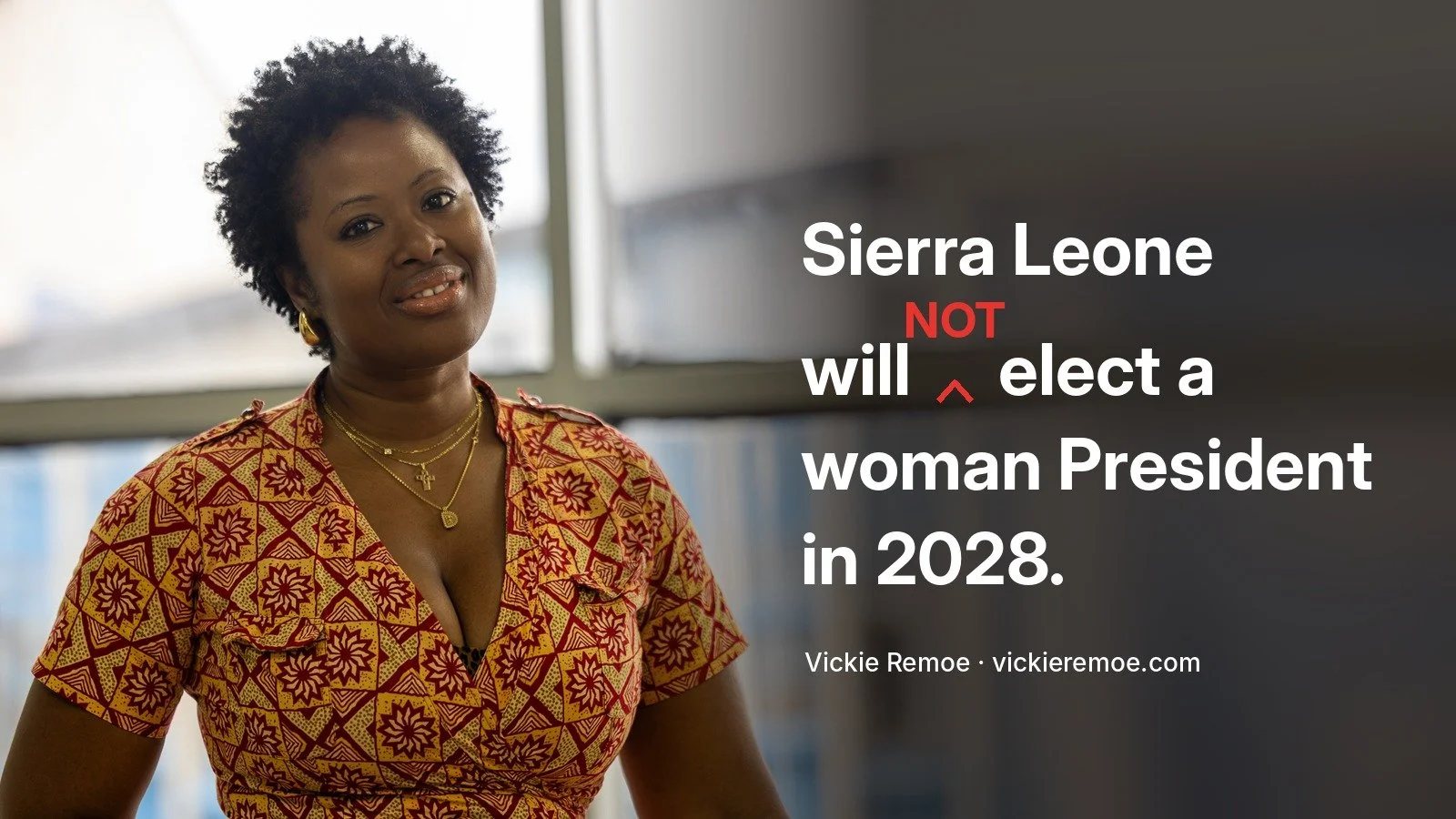
Sierra Leone will not elect a woman President in 2028
My phone rings at least once a week with the same call. A friend of mine runs a company in Freetown, and like every business owner in Sierra Leone, he lives by the political cycle. Our elections are long and disruptive, and, as anywhere in the world, State House sets the policies his business has to work within. So who comes next matters to him, and he collects rumours. "Vickie, dem say na dis person dem de gi." A week later, it's someone else.
Lately, more and more of those names belong to women. The Institute for Governance Reform's latest survey has the First Lady leading SLPP delegate support. Yvonne Aki-Sawyerr wants the APC flag. Femi Claudius-Cole already leads her own party. Freetown is talking about one question: will 2028 be the year of the woman?
So I posted my answer on Facebook. You think Sierra Leoneans will elect a woman President in 2028? PODOR. More than a thousand of you reacted, and hundreds of you argued in the comments. Many of you thought I was joking.
I wasn't. Let me be clear: I do not believe the Sierra Leonean electorate will vote a woman into State House in 2028. In a free and fair election, I believe any party that puts a woman at the top of its ticket is setting itself up to lose.
To my friend, and to everyone else making plans around 2028, here is one thing you can stop worrying about. The next President of Sierra Leone will be a man.
This is not about whether women can lead
Before anyone runs to the comments, let me say what I am not saying. I am not saying Sierra Leonean women are incapable. I am not saying the women in the race are not qualified. My argument is about who is voting, how they vote, what has happened to the women who tried before, and how women have historically reached power in this country.
Sierra Leone's median age is about 19. Think about what a 19-year-old voter has actually seen in her lifetime. In Bo, she may have grown up near a woman paramount chief. The South has a long memory of women in authority, going back to Macarico, the woman Portuguese sources say led the Mane south in the 1500s. In Kenema, too, a young person may have grown up under a woman chief, because some have held the throne for decades. But the 19-year-old in Makeni or Koinadugu has no such point of reference. In their lifetime, they have not seen a woman paramount chief.
The women leaders they do know are the big businesswoman in town or the women's leader at the market. Look closely and you'll see the pattern: when women lead in Sierra Leone, they mostly lead other women. Rarely has a young person in Bo, Makeni or Kono watched a woman lead men.
There is one place where that pattern breaks: the judiciary. Women sit on our highest courts, preside as judges and magistrates, and practise and lead at the Bar. In 2008, Umu Hawa Tejan-Jalloh became our first woman Chief Justice, and Priscilla Schwartz later became the first woman Attorney-General. The Sierra Leone Bar Association has been led by Basita Michael and by Tuma Adama Gento Kamara (née Jabbi). In October 2026, the Bar elected another woman, Martina Baindu Egbenda, unopposed. Yes, the presidency has a hand in senior appointments. But in the law, advancement rests largely on merit and long service. Where the playing field is level, Sierra Leonean women lead, and they excel. The problem has never been ability. It is the ballot box, and the culture behind it.
Our culture has a saying for this, spoken and unspoken. The man is the head and the woman is the neck. The man leads and the woman assists. That's why in organisation after organisation, the president is a man and the deputy is a woman. We like to tell ourselves we've moved past that. We haven't. Not enough has happened, in our chiefdoms, in the state, in business or in our homes, to uproot a belief that deep.
Let's look at the numbers
I am a journalist, so let's not argue with feelings. For sixteen years, from 2007 to 2018, women held about 13% of the seats in Parliament. Election after election, the number barely moved.
Then in 2023 it more than doubled, to 30%. Three things lined up to make that happen. President Bio directed that the election be run by proportional representation, and the Supreme Court upheld it. The Public Elections Act 2022 required parties to put one woman on their lists for every two men. And the GEWE Act set a 30% target for women across public life. Under PR you vote for a party, not a person, and the parties had no choice. That congruence is what made it possible, and it deserves to be celebrated.
But look at what the parties did when they did have a choice. Under PR, the name at the top of a list is the one the party wants in most. If only one seat comes from that list, that is the person who gets it. Of 63 party lists in 2023, only four had a woman at the top. The APC had none.
Now apply that to 2028. The presidency is the ultimate one-seat contest. There is no list, no quota and no one-in-three rule. It is a man against a woman, head to head, before the whole country. If parties would not risk a woman at the top of a district list, why would they risk her at the top of the national ticket? I believe none of them will. And if they want to win, I'm not sure they should.
The GEWE Act will not change that. It sets a 30% target, but there are no reserved seats, no sanctions, and nothing about the presidency. I'd argue that is exactly why it passed: it is easy to agree to something that has no consequences. If 2028 is not run on PR, I expect parties to miss the 30% target, and the number of women in Parliament to fall.
The candidate is not the President
Could a woman win the SLPP or APC flag? Yes, I think she could. Yvonne Aki-Sawyerr shows how it is done at a lower level. In 2018 she ran for mayor with the blessing of the then President, and the party embraced her. When she won again in 2023, she was the incumbent, in an APC stronghold. Women get elected where their party is already safe.
The presidency has no stronghold. The backing of State House can make you the candidate. It cannot make you the President. To win, you have to convince the whole country, including the North and the East, and the paramount chiefs who carry them.
That is how I read the IGR survey. The First Lady leads among SLPP delegates, the insiders. That makes sense to me. Among the women in the race, no one is closer to power than the wife of the sitting President. Her office sits inside the Office of the President, and her record is bound up with the presidency's record. An organised wing of her supporters inside the party is already behind her. They call themselves Ebema, short for Ebema Gbi, Mende for "it won't happen": a line from a speech in which she said the APC would not come back to power. (Hon. Tawa explains it to Phebean Swill on AYV.) For the party machine, she is the safe bet. Among ordinary supporters, the survey has Chief Minister David Sengeh ahead: younger, very visible, and with real appeal among young voters.
Let me be fair to her. If the SLPP believes a woman is electable nationally, and it believes Fatima Bio is the best and most electable of its aspirants, then it should give her the ticket. My argument is not about her. It is about what the electorate will do with any woman at the top.
Outside that, I struggle to name a woman with both a grassroots base and a national profile. As I see it, there are two routes. The first is the grassroots fireball: a woman who makes her name fighting for change in her region, wins a seat in Parliament, rises to cabinet, and becomes known as a woman for the people. The second is the international route, the Tejan Kabbah route: make your name at home, serve in cabinet, spend years at the UN, and come home with the pedigree. Dr Kadi Sesay came closest when she was the SLPP's running mate in 2012. Zainab Hawa Bangura ran for President in 2002, just after the war, before her UN years, and lost badly. Today she fits the international route better than anyone. Right now, I don't see a woman in Sierra Leonean politics on either route.
Walking into the lion's den
For a woman, entering politics in Sierra Leone is violent. The danger is not only physical. It is in the language, the insults, and the way people talk about you. A woman carries her whole family into the fight with her: the pressure on her marriage, a husband who now has to answer for her, children whose safety she has to worry about. In a culture that holds a woman's respect as sacred, stepping into politics means knowingly walking into the lion's den.
UN Women recorded 202 violent incidents against women in the 2023 election cycle. That number does not surprise me. And remember, that was under PR, where women were not even fighting men head to head for a seat.
Nothing protects these women. Not enough has been done to condemn this violence, online or offline, and not enough has been done to punish it. If our political parties truly want women to take part, they need zero tolerance for violence against women inside their own structures. Until then, the only woman who can run without fearing for her physical safety is the one campaigning while her husband holds power. Even she will face the vitriol and the online abuse. But she will be the most protected woman in the race. My sincere hope, though I am not holding my breath, is that whatever protection the state gives her becomes the standard for every woman who runs.
Then there is Zainab Sheriff. She chairs Wi Duti, the Lappa Movement, which launched last year to push both big parties to put up a woman for 2028. Today she is in prison, serving a four-year sentence over remarks she made at an APC rally. I won't repeat what she said, because I don't want to make things worse for her. Her words were callous. But men have said worse, and done worse, and they are still free. Her APC co-accused from the same rally got bail within five days. She was refused it again and again.
I believe that if Zainab Sheriff were a man, she would not be serving four years today. The system gives women far less room to "misbehave" in politics. Men get a much wider berth. And every young woman watching, every woman who is not yet a mammy, is learning what happens to women like her when they step forward.
Custom, and the mammification of the presidency
Outside Freetown, custom still shapes what people do and what they accept, and it will shape the national vote too. In the South, and in Mende chiefdoms of the East such as those in Kenema District, women can and do become paramount chiefs. Madam Satta Gendemeh has ruled her Kenema chiefdom for more than 50 years, and Madam Theresa Vibbie of Kandu Leppiama was the country's oldest serving paramount chief when she died in 2025. Even in the East, though, women chiefs are still very few. In the North, and in parts of the East such as Kono, custom still bars women from the throne. The North is also where girls have the hardest road: Falaba has the lowest literacy rate in the country, at 20%. Whether a woman candidate runs for the APC or the SLPP, I expect her to get less support from voters in the North and the East.
Then there is age. Look at the small group of African women who have reached the presidency. Ellen Johnson Sirleaf was 67 when she was elected. Netumbo Nandi-Ndaitwah was 72. Samia Suluhu Hassan and Joyce Banda were both 61 when they stepped up from the vice presidency. I call it the mammification of the African presidency. The older a woman is, the more respect she gets, and the "safer" people believe she is.
To be trusted with the country, a Sierra Leonean woman has to be a mammy who has proved herself to her party and to the public, usually by doing far more than any man who reaches the same seat. In 2028, Fatima Bio will be 47. By that measure, her age works against her. Her track record is her record as First Lady, which is bound up with the presidency itself. And as the SLPP's candidate, she would be running to continue her husband's legacy.
No one expects brotherhood at the ballot box
The comments on my post proved the point better than I could. The top comment said a woman President would need to be "stable," "mature," and "mentally prepared." Have you ever heard anyone say that about a male candidate? Never. That is a dog whistle. Read between the lines and it says women are unstable, immature and unprepared.
Many of you asked, "Which woman?" That question puts the problem on the women. My argument is not about the women. It is about us: our attitudes, our perceptions, and what is really happening on the ground.
And many of you, women included, said that women don't vote for women. Patriarchy does not only live in men. Women who grow up in a patriarchal society can carry the same prejudice against women, in the same way that people can absorb prejudice against their own race. But I want to push back on the other side too. Telling women to vote for a woman because she is a woman is also prejudice. No one tells men to vote for men. No one expects brotherhood at the ballot box. Men are judged on merit, and so should women be.
Gender is not how I vote. I have voted for the APC, for Ernest Bai Koroma, and I have voted for the SLPP, for Julius Maada Bio. I judge the government in power: what it got right, what it got wrong, and whether most Sierra Leoneans would be better off with it or with someone new. I am a progressive realist. I want able men and women serving this country. I am simply telling you what I see.
What would make me say "will"
So what would have to change for me to write Sierra Leone will elect a woman President in 2033?
Women in leadership would have to be more than a quota. It would have to be a trend. I would need to stop seeing the deputy job reserved for women. I would need to see 2028 be safe for women who run. If 2028 is not run on PR, I would need to see voters still elect women in large numbers. If it is, I would need to see parties put women first on their lists, not third.
We need to see it to believe it. Until we see it, it is not even a dream. Na smoke.