The Shocking Truth Of Sierra Leone’s Diamond Crisis - It's Not What You Think
A global visibility feature, straight from my heart and the team at Make Sierra Leone Famous, in partnership with the National Minerals Agency (NMA), as we dive deep into our nation's journey toward resource ownership and diversification during Mining Week 2026 (May 19 - 23).
For so long, the world has held a single image of Sierra Leone in its mind — a narrative cemented by the shadows of our civil war and the harsh spotlight of the 2006 Hollywood film, "Blood Diamonds." It’s a compelling, resource curse trope that suggests our entire economy lives and dies by the fate of a single stone.
But ah wan make yu no say, da stori day na old yus: that narrative is now officially old news.
When I saw the headlines about the global diamond market catching a serious cold last year — the kind that forced four of our biggest diamond mines into a care-and-maintenance pause — I’m sure I wasn't the only one holding my breath. The usual chorus of external analysts warned us to brace for imminent economic collapse.
But that crash never came, and everyone was shocked. Instead, our country, my Sierra Leone, quietly flexed more economic muscle than most people knew we had.
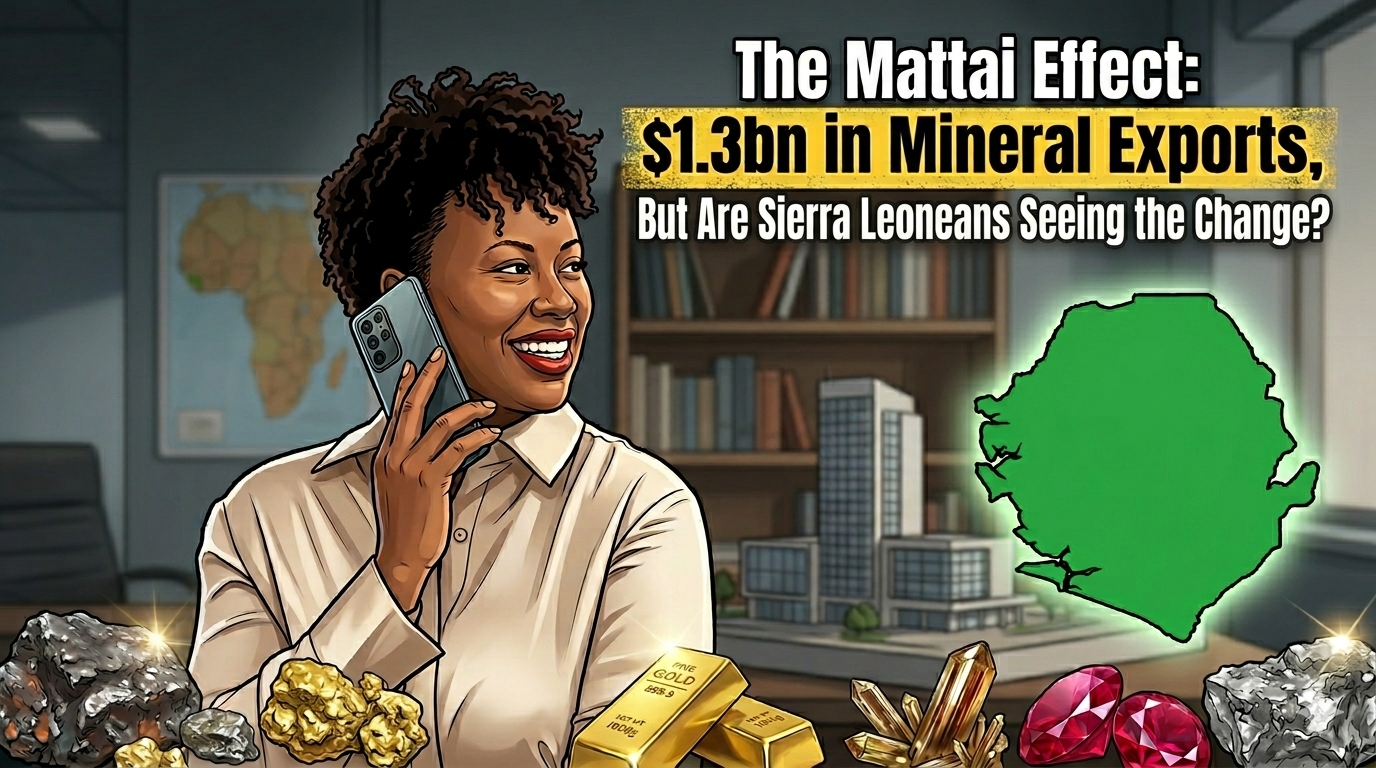
I looked at the numbers from the Ministry of Mines and Mineral Resources, and the National Minerals Agency (NMA). The data speaks for itself: our mineral exports leaped by a massive 16% year-on-year, bringing in a staggering USD 1.3 billion in 2025. What others saw as a looming disaster, I see as a real-time stress test: a test our aggressive push for economic diversification is passing with flying colors.
Sierra Leone Mineral Export Revenue (2025)
Iron Ore (Kingho & Marampa Mines) 69%
Other Minerals (Bauxite, Gold, Sands, Diamonds) 31%
Total: USD 1.3 Billion
Where Our Wealth Is Really Coming From
We have been vulnerable for too long to the whims of single-commodity markets. But our new national playbook is changing that. Yes: Iron Ore is still the undisputed anchor—Kingho Mining (Leone Rock) and Marampa Mines held down a steady, impressive 69% of our total export value. But, to me, the remaining 31% is where the magic - the real story of a nation growing up - is unfolding.
Take a look beyond the old diamond pits of Kono, and you’ll find more gems:
The Bauxite Boom: I am particularly excited about the Mokanji Development Project, which kicked off in January 2026. That single enterprise triggered a mind-boggling 620% spike in bauxite royalties! Its exports are projected to climb from 6.3 million tonnes to a colossal 11 million tonnes annually by 2027. This isn't just a number; it’s a major economic revival for Sierra Leone’s Southern Province.
Digging Deep for Gold: We are evolving. Operators like Gold Lion are moving beyond basic open-pit methods and going deep underground; unlocking long-term, high-grade reserves that set the stage for an incredible 2,260% production ramp-up, projected to jump from a modest 16,000 ounces to a staggering 380,000 ounces annually by 2027.
We're Not Just Digging Up Raw Earth Anymore: This is perhaps the best news yet. In the mineral sands sector, companies like Sierra Rutile (now under Sierra Leonean-ownership after 50 years), Minenet, and Foison Resources are investing serious capital in domestic Mineral Separation Plants (MSPs) right here at home. With new infrastructure, including a targeted 830,000-tonne capacity barge jetty, we are finally capturing and adding value insai Salone.
The Diamond Engine: Coiled, Not Broken
I want to be clear: Sierra Leone hasn't given up on diamonds. Instead, we’re showing we can be strategic and outsmart a global market downturn. The temporary operational pauses at Meya Mining, Seawright, Sierra Diamonds, and Tonguma are structural breathers, not signs of failure.
The focus is on protecting our people and our assets. I was excited to see Meya Mining and Sierra Rutile both secure ECOBANK financing facilities in February 2026, ensuring they are fully resourced for a meaningful comeback and expansion. Similarly, Newfield Resources pumped $5.5 million into Tonguma to clear fees and keep the site structurally primed. By keeping our local engineers employed and machinery maintained, our diamond engine remains coiled, ready to spring back the moment the global luxury demand finds its feet again.
The Human Heart of the Economy
These statistics are not abstract figures. They tell a clear story of survival, dignity, and renewed hope for Sierra Leone’s mines.
Today, the formal mining sector employs 15,543 of our people: better than global standards. And here is the fact that makes me proud: 92.3% of those workers are Sierra Leonean citizens. That means 14,350 local jobs that sit well above the national average salary. Jobs that directly put food on the table for an estimated 70,000 to 100,000 family members. That is nearly 2% of our entire population feeling the direct, stabilizing lift of this new, diversified mineral economy.
Sierra Leone’s 2028 Mining Vision
The road ahead is as expansive as it is exciting. Driven by the explosive momentum in bauxite and gold, Sierra Leone’s total mineral exports are conservatively projected to nearly double, reaching an annual USD 2.0 to 2.5 billion by 2028.
But we cannot be complacent. State House must execute swiftly. The NMA and the Ministry are pushing hard for decisive Cabinet action in the next 90 days. We need to harmonize the landmark Mines and Minerals Development Act (MMDA) 2023 with the agency laws it is currently in conflict with. And crucially, we must invest in international pricing benchmarks to finally shut the door on the transfer pricing leaks bleeding our nation dry.
The old story of Sierra Leone was fragile, written by the unstable fortunes of a single stone. The new story, the one we have been forging together since 2025, is about resilience, diversification, and an economy that refuses to be broken by external shocks. By prioritizing a value-added mineral ecosystem that puts Sierra Leoneans first, we are charting our own course toward shared prosperity, and I, for one, am excited to see us succeed.